
Six SkillS. One Mental Performance System
The Mental Performance & Skills System (MPSS) gives athletes, coaches, parents, and directors a practical framework for navigating pressure.
Each skill addresses a different challenge—recovering after mistakes, maintaining focus, responding to adversity, letting go of the past, accepting reality, and staying open to coaching. Together, they form a flexible system that helps athletes recognize what's happening, choose an effective response, and continue performing and learning.
One system. Many entry points. Endless opportunities to grow.
How Do I Help Athletes Recover After Mistakes?

Help Athletes Recover Before Mistakes Become Momentum
One mistake doesn't usually cost a match. The emotional reaction to that mistake often does. Frustration, embarrassment, or self-criticism can quickly take over, leading to rushed decisions and repeated errors.
The STOP Skill teaches athletes to create a brief pause between the event and their response. Instead of reacting automatically, they learn to slow the moment down, regain control, and choose their next action with intention.
For coaches, this means athletes who recover faster, remain coachable under pressure, and consistently return their attention to the next job.
Best used when:
-
Immediately after mistakes or missed opportunities
-
During momentum swings
-
Following questionable officiating or frustrating situations
-
When emotions begin to interfere with performance
-
Before refocusing on the next play
How Do I Keep the Last Play From Ruining the Next One?

Keep the Last Play From Stealing the Next One
Athletes can regain their composure and still remain mentally stuck in what just happened. A missed serve, bad decision, or frustrating call begins replaying in the mind, pulling attention away from the action unfolding in front of them.
Rumination Recovery teaches athletes to recognize when they have entered that replay loop, interrupt it with a brief cue, and deliberately return their attention to the present play. The goal is not to ignore mistakes, but to keep reflection from interfering with immediate performance.
For coaches, this means athletes who spend less time mentally trapped in the past, recover their focus more quickly, and remain available for the next read, decision, and action.
Best used when:
-
An athlete continues replaying a recent mistake
-
Body language shows they are still carrying the previous point
-
Hesitation or slower reactions appear after an error
-
Attention keeps drifting backward during competition
-
The athlete needs to reconnect with the next ball, assignment, or play
How Do I Help Athletes Stop Fighting Reality?

Stop Fighting Reality So Athletes Can Move Forward
Some moments in sport cannot be changed. A bad call, an injury, difficult weather, an opponent's great play, or a coach's decision may feel unfair, but resisting reality only drains attention and emotional energy.
Radical Acceptance teaches athletes to acknowledge reality as it is, without approving of it or giving up. By letting go of the fight against what cannot be controlled, they can redirect their energy toward the next choice, the next adjustment, and the next opportunity.
For coaches, this means athletes who spend less time arguing with reality, recover more quickly from uncontrollable setbacks, and stay focused on what they can influence.
Best used when:
-
An athlete is frustrated by an official's call or a coach's decision
-
Conditions or circumstances are outside the athlete's control
-
Energy is being wasted wishing things were different
-
The team needs to move on after an uncontrollable setback
-
Accepting reality is the first step toward making the next effective play
How Do I Keep Athletes Mentally Present?

Keep Athletes From Playing Through a Smudged Lens
Even highly skilled athletes stop seeing the game clearly when their attention becomes cluttered. One mistake, one distraction, or one anxious thought can narrow awareness and interfere with decision-making.
Mindfulness Reset teaches athletes how to recognize when their attention has drifted and deliberately return it to the present moment. Rather than dwelling on the last point or worrying about the next one, they learn to reconnect with the ball, the play, and the information in front of them.
For coaches, this means athletes who make better reads, communicate more effectively, and stay mentally engaged throughout the match.
Best used when:
-
Athletes appear distracted or mentally absent
-
Errors begin to snowball because attention has wandered
-
Between rallies, timeouts, or substitutions
-
Before serves or other high-focus moments
How Do I Keep Setbacks From Becoming Discouragement?
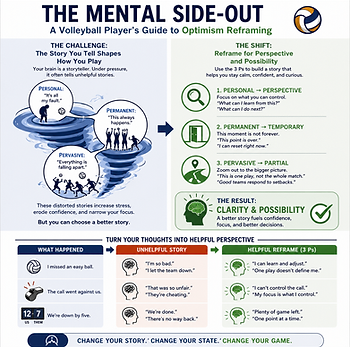
Keep One Mistake From Becoming a Bigger Story
Athletes do not respond only to what happened. They also respond to the meaning they give it. A missed serve can quickly become “I’m falling apart,” while one difficult rotation can become “Nothing is working.”
Optimism Reframing teaches athletes to separate the objective event from the exaggerated story that follows it. Rather than forcing positive thinking, they learn to replace distorted interpretations with grounded, useful ones that support the next action.
For coaches, this means athletes who recover perspective more quickly, remain connected to solutions, and are less likely to let one difficult moment shape the rest of their performance.
Best used when:
-
An athlete begins catastrophizing after a mistake
-
Self-talk becomes harsh, global, or defeatist
-
One error starts affecting confidence in later plays
-
The athlete assumes they know what a coach or teammate is thinking
-
A more accurate interpretation would help identify the next useful adjustment
How Do I Correct Mistakes Without Creating Fear or Tension?

Protect the Relationship So Athletes Can Hear the Coaching
Athletes are most able to receive feedback when they feel safe, respected, and understood. When correction is delivered through frustration, criticism, or embarrassment, athletes may become defensive, shut down, or focus more on the coach’s reaction than the adjustment itself.
Connection Over Correction teaches coaches to establish emotional contact before delivering instruction. This does not mean avoiding accountability or lowering standards. It means using tone, timing, and relationship to make correction easier to hear and apply.
For coaches, this means athletes who remain open to feedback, recover more quickly from difficult interactions, and are better able to translate instruction into effective action.
Best used when:
An athlete appears embarrassed, overwhelmed, or defensive
Repeated correction is no longer getting through
Emotion is interfering with the athlete’s ability to listen
A coach needs to address a mistake without increasing fear or tension
Preserving trust will make the next instruction more effective
One System. Many Entry Points.
Pressure does not affect every athlete in the same way. One athlete may become overwhelmed. Another may lose focus, replay a mistake, resist a difficult reality, or shut down when receiving feedback.
MPSS helps athletes and coaches identify what is getting in the way right now and select the skill that best fits the moment. The six skills are not taught as a rigid sequence. Any skill can become the starting point.
Sometimes one skill is enough. At other times, several skills work together. An athlete may use STOP to interrupt an emotional reaction, Mindfulness Reset to return attention to the present, and Optimism Reframing to regain perspective.
The goal is not simply to memorize six techniques. It is to build the awareness and flexibility to recognize the challenge, choose an effective response, and return to the moment in front of you.
How the Dashboard Works
Notice what is happening internally.
Identify the barrier interfering with performance.
Select the skill that best matches the moment.
Apply it with intention.
Return to the next effective action.
Different challenges. Different skills. One shared purpose: helping athletes respond more effectively under pressure.
How Do the Six SKills Work Together?
